::::: :: ADSR envelope: When an acoustic musical instrument produces sound, the loudness and spectral content of the sound change over time in ways that vary from instrument to instrument. The "attack" and "decay" of a sound have a great effect on the instrument's sonic character.[29] Sound synthesis techniques often employ an envelope generator that controls a sound's parameters at any point in its duration. Most often this is an "ADSR" (Attack Decay Sustain Release) envelope, which may be applied to overall amplitude control, filter frequency, etc. The envelope may be a discrete circuit or module, or implemented in software. The contour of an ADSR envelope is specified using four parameters: Schematic of ADSR Attack Decay Sustain Release Key on off Inverted ADSR envelope Attack time is the time taken for initial run-up of level from nil to peak, beginning when the key is first pressed. Decay time is the time taken for the subsequent run down from the attack level to the designated sustain level. Sustain level is the level during the main sequence of the sound's duration, until the key is released. Release time is the time taken for the level to decay from the sustain level to zero after the key is released. An early implementation of ADSR can be found on the polyphonic 1938 Hammond Novachord (which predates the first Moog synthesizer by over 25 years). A seven-position rotary knob set ADS for all 72 notes; a footpedal controlled release.[30] ADSR was specified by Vladimir Ussachevsky (then head of the Columbia-Princeton Electronic Music Center) in 1965 while suggesting improvements for Bob Moog's pioneering work on synthesizers, and earlier parameter notations (T1, T2, Esus, T3) were finally simplified to current form by ARP.[31] Some electronic musical instruments allow the ADSR envelope to be inverted, which results in opposite behavior compared to the normal ADSR envelope. During the attack phase, the modulated sound parameter fades from the maximum amplitude to zero then, during the decay phase, rises to the value specified by the sustain parameter. After the key has been released the sound parameter rises from sustain amplitude back to maximum amplitude. 8-step envelope on Casio CZ series A common variation of the ADSR on some synthesizers, such as the Korg MS-20, was ADSHR (attack, decay, sustain, hold, release). By adding a "hold" parameter, the system allowed notes to be held at the sustain level for a fixed length of time before decaying. The General Instruments AY-3-8912 sound chip included a hold time parameter only; the sustain level was not programmable. Another common variation in the same vein is the AHDSR (attack, hold, decay, sustain, release) envelope, in which the "hold" parameter controls how long the envelope stays at full volume before entering the decay phase. Multiple attack, decay and release settings may be found on more sophisticated models. Certain synthesizers also allow for a "delay" parameter, which would come before the "attack". Modern synthesizers like the Dave Smith Instruments Prophet '08 have DADSR (delay, attack, decay, sustain, release) envelopes. The delay setting determines how long there is silence after a note is hit, before the attack is heard. Some software synthesizers such as Image-Line's 3xOSC (included for free with their DAW FL Studio) have DAHDSR (delay, attack, hold, decay, sustain, release) envelopes. full, free, download, no torrent, warez, crack, keygen, serial, MediaFire, HotFile, FileJungle, RapidShare, FileSonic, Wupload, FileServe, blogspot - -: : : -:      

Menu

»

Home

ADSR Envelope 

ADSR is an acronym that stands for Attack, Decay, Sustain, Release and is a means to replicate those respective elements of a sound.
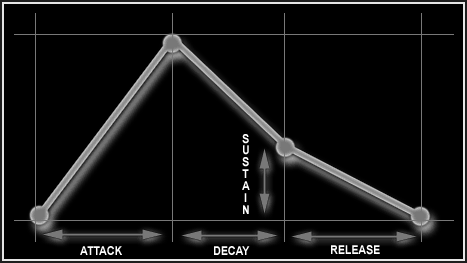
 ADSR is an acronym that stands for Attack, Decay, Sustain, Release and is a means to replicate those respective elements of a sound.It is especially used in sound designing with electronic music instruments.  

The envelope is a form of automation (automatic movement) built into synthesizers to control the value of a parameter (usually volume or filter cutoff frequency) over time. Envelopes are critical for giving synthesizers a more natural and interesting sound, as they can be used to simulate the volume envelopes of a real instrument. However, envelopes are also great for creating special effects. The most common type of envelope is called ADSR (Attack, Decay, Sustain, Release), referring to the different functions of each part of the envelope.


ADSR Envelope elements:

  • Attack - Attack determines the time it takes for the note to get to the maximum level.

  • Decay - Decay determines the time it takes for the note to go from the maximum level to the sustain level (controlled by Sustain).

  • Sustain - Sustain determines level the sound is played at while the note is held (after the other envelope states, Attack and Decay, have been completed).

  • Release - Release determines the time it takes for the note to fall from the sustain level to zero (silence) level when it is released.


Syntheway Virtual Musical Instruments © 2004-2012 Daniel Alberto Laiseca| Buenos Aires - Argentina|

Privacy Policy | Disclaimer | FAQ | Site Map Artists & BandsTechnical Support ContactAbout Us