Drawbar, Transistor and
Combo Organs, Reed
Harmonium, Accordion and Bandoneon
Please try
the
demo
version
before purchasing
(Plugins
non-refundable)
Overview
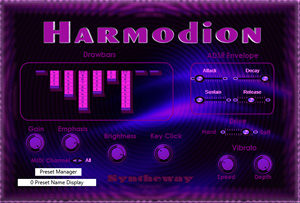
Harmodion
is an
organ
and a free-reed aerophone virtual instrument, which includes electronic,
clonewheel drawbar, transistor and combo organs, as well as
reed harmonium, flutina, accordion and bandoneon. It uses additive
synthesis allowing
to manipulate harmonically the sine waveform components to produce pitched sounds, as well as
to individually detune those components to produce inharmonic timbres.
A set of sliding drawbars are used to mix the various
harmonic components generated by the tonewheels emulation in
order to synthesize a wide variety of sounds.
Available as an instrument plugin in VST and VST3 64 bit versions for Windows.
Features
9
Drawbars. By sliding drawbars in or out, the user can mix various pitches and create the richly distinctive sounds
of an electric organ or of a free reed aerophone instrument.
The Additive synthesis constructs complex sounds by controlling the level of individual sine-wave components.
The sound can be reshaped by alterations made to timbre. A harmonic sound could be restructured to sound inharmonic, and vice versa.
The rich harmonic content of their sound allows to generate the widest
palette of tonal variations from
tonewheel
drawbar
and electronic organs to squeezeboxes (hand-held
bellows-driven) emulations. Legendary combo organs can be modeled in
order to approach to those classics like the Farfisa Compact Organ
and Vox Continental Transistor Combo Organ, among others.
Vibrato
effect, with depth and speed
modulation control.
Adjustable
Key Click
simulation to add the percussive effect for distinctive organ sounds and
button click noise in Accordion and Bandoneon presets.
Configurable
Drive level. Accomplished by clipping the input signal, this effect adds sustain and additional harmonics and overtones to the signal, creating a richer sound
with a warm thickness regarding to the original tone.
MIDI Automation.
Implementation of MIDI Continuous Controller parameters for use with
external hardware control via DAW
.
Preset Manager:
'Browser' to load and save presets and banks, enabling
to export to *.fxp (VST2 Preset), *.fxb (VST2 Bank),
*.vstpreset (VST3 Preset), *.aupreset (Audio Unit
Preset) plus two generic formats (plain text): the
*.xmlpreset (XML Preset) and the *.xmlbank (XML Bank),
providing cross-platform presets/banks. This allows to
control over the loading and saving of presets from disk
as well as sharing presets between different plugin
formats using the generic *.xmlpreset (XML Preset) and
the *.xmlbank (XML Bank).
64
presets available for
immediate use in a wide range of genres from blues, jazz, gospel and rock styles to folk, ethnic and popular music,
and lets you create your original sounds from these
presets:
#
List of
64 Preset Sounds
1
Initial Default Organ
2
Drawbar Organ
3
Orgue de la Chapelle
4
Vibratone Reed Aerophone
5
Flute Organ
6
Tan-Go (Tango Accordion)
7
Fantasy Organ
8
Squeeze Accordion
9
Organphone
10
Harmonicon
11
Overdrive Organ
12
Harmonium
13
Reed Organ
14
Calliope Circus Organ
15
Soft Organ
16
Percussive Organ
17
Hard Overdrive Organ
18
Odd Organ
19
Accordion
20
Hammondish B3
21
Bandoneón
22
Rock Organ
23
Elektro-Orgel
24
Pure Organ
25
Blues Organ
26
Dirty Organ
27
Rotary Organ
28
Metalized Rock Organ
29
Space Organ
30
Telharmonium (Dynamophone)
31
Flutina Accordion
32
VibraphOrgan
33
Nostrum Organ
34
ElectrOrgan
35
Neo-Accordion
36
Rocker Organ
37
Farfisa Compact Organ Mode 1
38
Farfisa Compact Organ Mode 2
39
Farfisa Compact Organ Mode 3
40
Farfisa Compact Organ Mode 4
41
Farfisa Compact Organ Mode 5
42
Vox Continental Combo Organ
Mode 1
43
Vox Continental Combo Organ
Mode 2
44
Vox Continental Combo Organ
Mode 3
45
Vox Continental Combo Organ
Mode 4
46
Vox Continental Combo Organ
Mode 5
47
Illusion Organ
48
Vibrato Percussive Organ
49
Milky Way Organ
50
Intemperance
51
Shrine Organ
52
Gritty Overdriven
53
Digital Concertina
54
Binaural Pad Organ
55
Glassy Drawbars
56
Archangel Call
57
Surreal Atmosphere
58
Piccolo Feeling
59
Crystal Marimba
60
Glass Armonica
61
Electro Melodeon
62
Electro Bandoneon
63
Panned Particles
64
Gospel Soul C3
Presets Sounds Demo ↓
Before installing any VST, VST3 or Audio
Units plug-ins, please make sure your computer meets the
following requirements. Please test the
demo version of this
product
extensively on your host to make sure there are no
problems before
purchasing.
Windows operating system: Windows 11, Windows 10, Windows 8,
Windows 8.1, Windows 7 64 bit.
VST and/or VST3 compatible host / digital audio
workstation DAW / MIDI sequencer 64-bit: This VST/VST3 software can be
"plugged" into any host application that supports VST/VST3 technology,
such as Image-Line FL Studio, Steinberg Cubase Pro, Artist and Elements,
Cakewalk by BandLab, Ableton Live, Cockos REAPER, PreSonus Studio One,
Acoustica Mixcraft, MAGIX Acid Pro, MakeMusic Finale, Avid Sibelius,
Mackie Tracktion, Steinberg Nuendo, Magix Samplitude, Magix Music Maker,
Cantabile (Lite, Solo, Performer), n-Track Studio, VSTHost, DarkWave
Studio, Bitwig, SAVIHost and many more.
MIDI controller device: A MIDI controller is required to play
this VST instrument. The most common device in this class is a keyboard
controller. After launching Digital Audio Workstation or your MIDI host
application, be sure to select the appropriate MIDI device before
attempting to play your MIDI controller.
An ASIO® sound card is recommended for low latency real-time
performance.
Limitations of
the Unregistered/Demo Version:
Same
sound quality than the full version. It generates a short beep in
all output channels every 10 seconds. Be aware that certain features
may not be available.
The full version is available to purchase, as downloadable software, the
price is